What We’re Learning: How DCPS Cut the Share of Below Grade-Level Readers in Half by Investing in Teachers 

Stronger Readers Start with Instruction That Works

When we supported the launch of the DC Public Schools (DCPS) Reading Clinic in 2018, early literacy data signaled a clear challenge: despite the district’s upward trajectory in reading achievement, many students were not meeting grade-level literacy expectations, and one in five students struggled with a reading disability. At the same time, many K-2 teachers lacked formal preparation in identifying and addressing difficulties, with only 28% of teacher preparation programs adequately covering all five components of science-based reading instruction. 

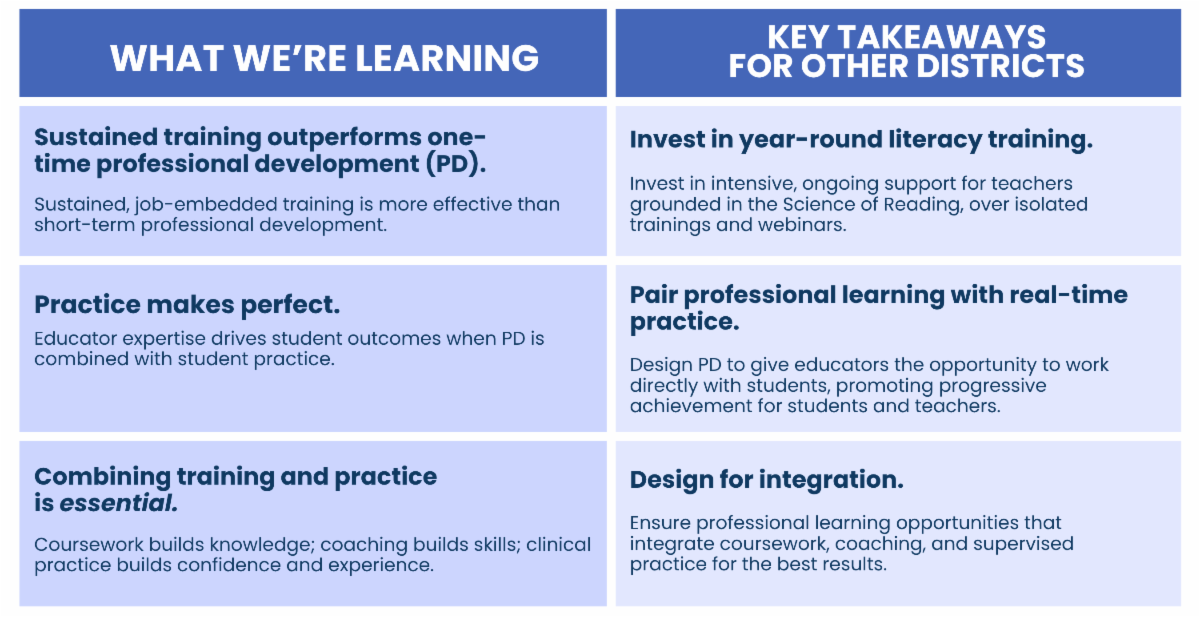
Research shows that students behind in reading at the end of first grade have just a one-in-eight chance of catching up. DCPS identified an urgent need for earlier, more targeted intervention. 

At the time, the DCPS Reading Clinic prioritized two goals; supporting struggling readers with intensive, individualized learning plans, and supporting teachers with thorough, evidence-based training. The initiative paired K-2 students with teachers and mentors for diagnostic-based instruction grounded in structured literacy, with lessons driven by ongoing assessment, progress monitoring, and clear goals. Meanwhile, a cohort of teachers participated in year-long coursework and received regular coaching support through modeling, side-by-side teaching, and observations to strengthen practice and deepen impact. 
In doing so, the clinic strengthened capacity of literacy teachers across DCPS, which, for a district with an impressively low teacher turnover rate, also represented a long-term investment. 

The DCPS Reading Clinic continues to prioritize high-impact tutoring and intensive educator coaching. Over time, the program has evolved to support not only classroom teachers, but also co-teachers, instructional leaders, and more recently, secondary educators and students—helping to build schoolwide literacy expertise across the district. Tutoring is used as not only support for students, but also as a strategy for building the teacher expertise–and it is working

What We’re Learning

The success of the clinic demonstrates that strengthening teacher effectiveness can bolster student learning. To date, the initiative has trained more than 700 DCPS educators and staff, reaching more than 9,000 students. Students taught by clinic-trained teachers demonstrated statistically significant reading gains compared to their peers whose teachers were not clinic-trained.

In School Year 2024-2025: 

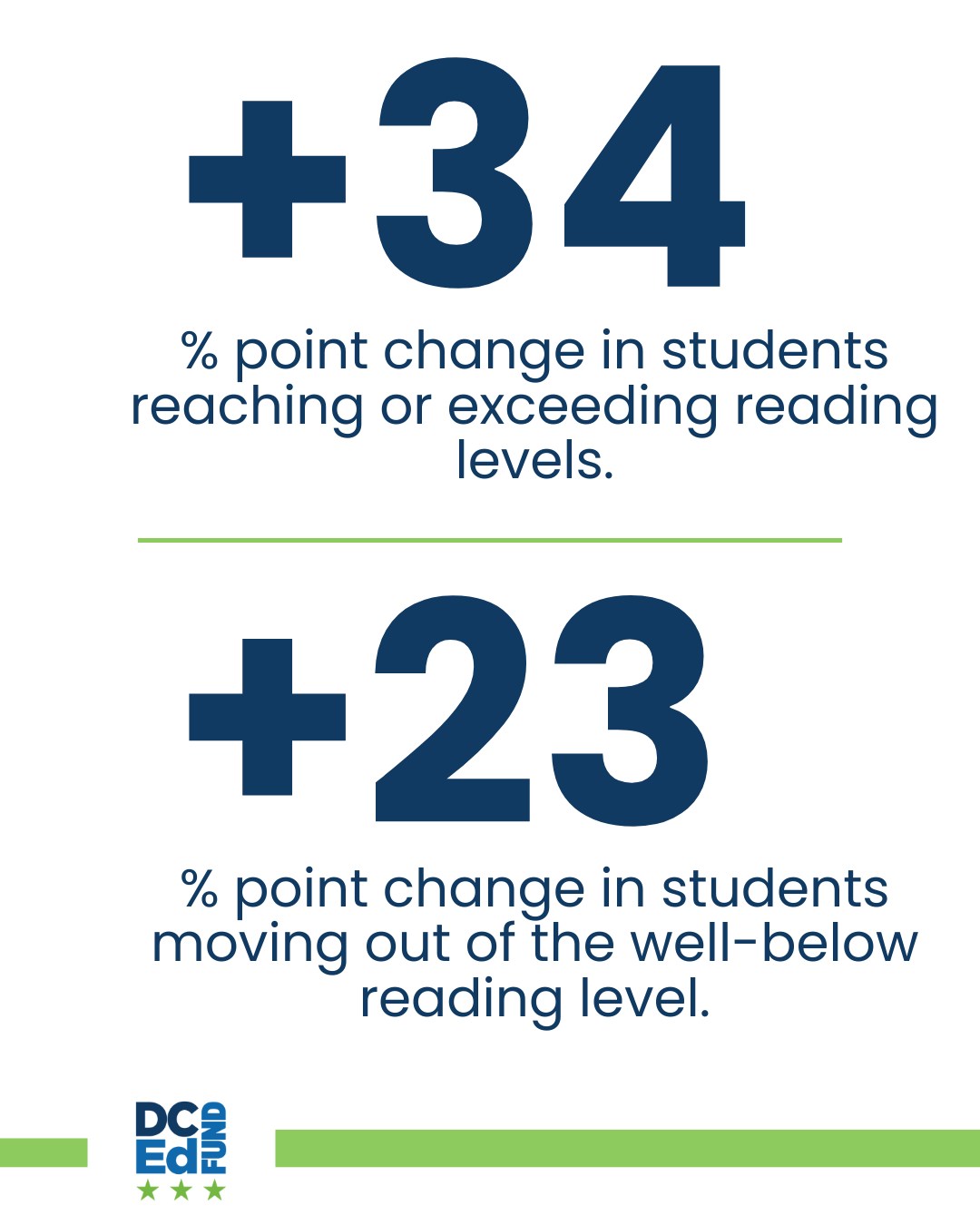
  • The percentage of at-risk students reading below grade level dropped from 70% at the beginning of the year to 33% by the end of the academic year. 
  • Classrooms taught by clinic-trained teachers saw a 34-percentage point increase in students reaching or exceeding grade-level standards
  • Students in clinic-trained classrooms were 10.2% more likely to advance at least one benchmark level during the year. 
  • Students who began the year well below benchmarks were more likely to move up a reading level or meet grade-level expectations by the end of the year. 

The results are clear: when teaching is strengthened through sustained practice and support, student outcomes improve significantly.
What’s Next

Building on these strong results, DCPS is focused on expanding access to the DCPS Reading Clinic to support more educators. Following the passage of legislation to address dyslexia in 2024, and based on recommendations from the DC Early Literacy Task Force, all kindergarten teachers must demonstrate structured literacy knowledge by the start of School Year 2026–2027. To meet this requirement for DCPS, the DCPS Reading Clinic trained all 300 kindergarten educators who have not already completed comparable coursework in School Year 2025-2026.

Over the past two years, the DCPS Reading Clinic has also expanded to strengthen literacy instruction in grades 3-12. With 25% of DC eighth graders scoring at or above benchmarks on the 2024 NAEP assessment, the need for strong, structured literacy practices in secondary settings remains clear. The DCPS Reading Clinic’s secondary program is the first in the greater DC region to offer specialized training in adolescent reading development paired with an in-person clinical practicum.

Scaling this model to new grade levels reinforces the core principle of this work: creating stronger readers does not end at short-term student intervention and requires comprehensive support.


This edition of What We’re Learning was led and authored by Michela Rynczak, Manager of Programs & Communications
Quarterly Newsletter | DC Ed Fund

I’m honored to join DC Public Education Fund as the new Managing Director of Strategy and Impact.

Over the past 15 years, I’ve had the opportunity to work across philanthropy, education, and nonprofit leadership, helping mission-driven organizations strengthen partnerships, grow impact, and support communities in meaningful ways. In just a short time here, I’ve already seen that spirit come to life — from visiting students at Phelps ACE and witnessing their drive firsthand, to cheering on young mathematicians at the Capital Math Classic, to celebrating the incredible educators honored at the Standing Ovation Spring Bloom event. Moments like these remind me why this work matters so deeply.

This newsletter highlights just a few of the exciting moments from this year: progress across the education scorecard, new opportunities to share what we’re learning, celebrations of student achievement, and the partnerships that continue to move this work forward.

I’m excited to be part of this community and look forward to building alongside all of you in the years ahead.

With gratitude,

Emerald Adeyemi

Managing Director, Strategy & Impact


School Year 25-26 Highlights

DC Leads the Nation in Academic Recovery

This year, DC was ranked #1 in the nation in both math and reading recovery by the Education Recovery Scorecard, a reflection of the extraordinary leadership, innovation, and commitment across DCPS and the broader education community.

These gains are the result of years of investment in strong instruction, high-impact tutoring, educator support, and bold public-private partnerships designed to help students thrive. We’re proud to support this work alongside DCPS leaders, educators, school communities, and partners across the city.

Read more about the latest scorecard results and the collaborative efforts helping drive progress for DC students.

Introducing the “What We’re Learning” Series

We’re excited to launch “What We’re Learning,” our new blog series that explores the lessons, successes, and challenges emerging from our work alongside DCPS and partners across the city.

The series will highlight insights from initiatives supporting students, educators, and schools across DC, while sharing reflections on what it takes to scale impactful solutions in public education. “What We’re Learning” will live within our new online Insights Center, a dedicated space on our website for stories, resources, and thought leadership connected to our work.

Be sure to read our first post from President & Executive Director Jim Kline, “What We’re Learning: How Strategic Investments Expand What’s Possible for Students.”

Congratulations to the Class of 2026

We proudly celebrate the graduating students across DCPS and our partner programs whose hard work, resilience, and determination have brought them to this important milestone.

Last year, DC reached its highest graduation rate in more than a decade, surpassing 78%, reflecting the continued progress being made across the city and the dedication of students, educators, families, and school communities alike.

We are especially proud to celebrate:

  • 3,000+ graduates reaching this important milestone
  • Our Class of 2026 students participated in college courses, career training, internships, and credential programs at higher rates than ever! Since 2023, there has been a:
  • 53% increase in Dual Enrollment participation
  • 22% increase in Career and Technical Education participation
  • 24% increase in acquisition of Industry credentials up
  • 93% of degree-seeking seniors submitting two or more postsecondary applications, including at least one college application

To all of this year’s graduates: congratulations on all you’ve accomplished. We cannot wait to see what comes next for each of you.

In Case You Missed It

DC Public Education Fund thanks Chancellor Dr. Lewis Ferebee for his leadership as DCPS’ longest-serving chancellor and his steady guidance through the pandemic and recovery years. During his tenure, DCPS rose to #1 nationally in academic recovery, graduation rates climbed, and investments in academic acceleration, CTE, and dual enrollment expanded across the city. We’re proud to have partnered alongside DCPS throughout this progress and look forward to continuing the work ahead.

Dr. Kim Jackson has been named Interim Chancellor of DCPS by Mayor Muriel Bowser. A lifelong educator and proven leader, Dr. Jackson has spent more than a decade advancing student achievement across DCPS, from Principal of the Year at Seaton Elementary to Chief of Schools. We have had the privilege of collaborating with Dr. Jackson for many years and have seen firsthand her commitment to students, families, and educators across the District. We look forward to continuing our partnership in support of excellent outcomes for every DCPS student.

More than 350 students from DCPS and public charter schools competed in the first-ever Capital Math Classic at Nationals Park, hosted by EmpowerK12 and the Washington Nationals. From elementary through high school, students showcased rigorous problem-solving and joyful learning in action. Events like this reflect the vision behind the Capital Math Collective and the growing momentum around math achievement across DC.

This spring, we visited Phelps ACE High School to see career-connected learning in action across robotics, carpentry, electrical, HVAC, and dual enrollment pathways. Students were engaged in hands-on learning experiences that are preparing them for college, careers, and leadership opportunities. This work is part of the city’s broader Compact 2043 vision to ensure every student has access to high-quality career-connected learning opportunities.

Eighth graders at a whiteboard, debating about a rectangle.

That’s the scene I walked into back this March while paying a visit to MacFarland Middle School. Sarah Bax, a DC Math Hub Bright Spots Math Fellow, had students working collaboratively in small groups at a whiteboard, a practice highlighted in Building Thinking Classrooms by Dr. Peter Liljedahl. The question on the table: if you hold a rectangle’s perimeter steady while adjusting the lengths of the sides, what happens to its area? They built tables and graphed their results, beginning to see the relationship take shape for themselves. Around the room, students compared strategies, defended their reasoning, and revised their thinking in real time.

None of that is accidental. It’s the kind of teaching we built the Capital Math Collective to spread. Backed by a $20 million grant we recently secured, the Capital Math Collective pairs teacher coaching with high-dosage tutoring and genuine family engagement. The goal is plain, yet ambitious: make DCPS the first urban school district in the country where every student beats the national average in math by 2030

At the DC Education Fund, we play a critical role in the city’s ability to invest in these types of solutions. Our organization was founded in 2007 to help DCPS address its most pressing challenges through organized philanthropy. As an independent organization, our team raises significant private dollars that allow the school district to try new things, figure out what works, and deliver it to more students. In effect, we’re DCPS’ very own venture fund.

The DC Education Fund has raised more than $225 million in private investment to reimagine how students learn, support educators in their work, and expand what an urban public school district can achieve. We mobilize philanthropy and turn bold ideas into fundable strategies, connecting DC Public Schools with the partners and resources needed to build and strengthen successful programs. By helping align resources with district priorities, we enable DCPS to move faster, learn from what works, and bring proven solutions to more students and educators across the city.

From ensuring classrooms are equipped with rich, standards-aligned instructional materials to reimagining the high school experience and boosting enrichment offerings for middle schoolers. From supporting college completion to building a pipeline of talented principals to establishing a reading clinic that offers intense, one-on-one decoding sessions for DCPS’ most struggling readers, the DC Education Fund helps make all of that work possible.

Today, DCPS is the nation’s fast-improving urban school district, ranking first in the nation for post-pandemic academic recovery among all 50 states. 

While opportunity gaps persist and proficiency in reading and math highlight the need for continued progress, DCPS is beating the odds on a number of important metrics. Graduation rates are at an all-time high, enrollment is climbing and teacher and principal retention is strong. Many of these gains have been supported by investments made possible through the DC Education Fund, and we stand committed to equipping DCPS with the support necessary to ensure more students are prepared to succeed in school, in the workforce, and in life

This is the first post in a new series, “What We’re Learning,” where we’ll share the successes and challenges we’ve experienced during the nearly 20 years of fundraising and launching new initiatives, including digging into the wins, stumbles, and data gleaned from our most impactful programs. We’ll also shine a light on the educators, school leaders, and schools doing exceptional work, and explore what others can learn from their success.

At a moment when we’re focused on scaling what works, we’ve cultivated a deep knowledge bank that we hope can inform replicable best practices across the country. We hope you’ll follow along!


Authored by Jim Kline, Executive Director & President

K-12 Dive: DC Public Schools leads nation in academic recovery. Here’s why.

A focus on strategic planning and programming drove impressive gains in the nation’s capital, writes outgoing chancellor Lewis Ferebee.

Read the full story here: https://www.k12dive.com/news/dc-public-schools-leads-nation-in-academic-recovery-heres-why/822418/

Education Scorecard: D.C. Leads the Nation in Academic Growth, Ranks 1st in Both Math and Reading Recovery

Washington, D.C. ranked first nationwide in math and reading recovery, driven by investments in tutoring, literacy, and the Capital Math Collective supporting thousands of DC students and educators.

Read the full article here: https://educationscorecard.org/states/district-of-columbia/

Read the full story here: https://educationscorecard.org/states/district-of-columbia/

DC News Now: DC students compete in citywide math competition at Nationals Park

DC students showcased their math skills at Nationals Park during the Capital Math Classic, a citywide competition celebrating academic excellence, teamwork, and STEM education across Washington, D.C.

Read the full article here: https://www.dcnewsnow.com/news/local-news/washington-dc/dc-students-compete-in-citywide-math-competition-at-nationals-park/

Read the full story here: https://www.dcnewsnow.com/news/local-news/washington-dc/dc-students-compete-in-citywide-math-competition-at-nationals-park/

The Capital Math Collective: Spring 2026 Newsletter

Friends and Supporters,

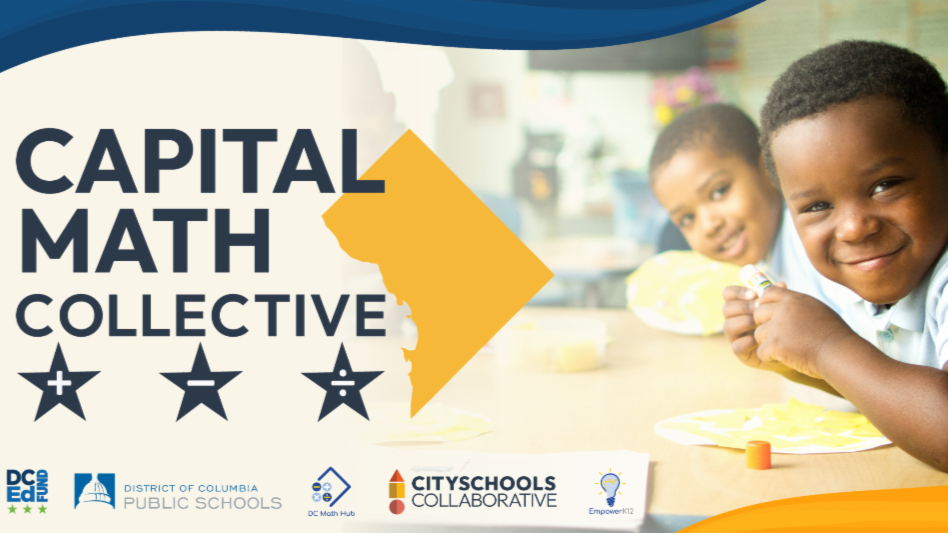
There’s so much underway across DC’s math community this spring—and we’re excited to share early signs of progress from the Capital Math Collective and its partner organizations: DC Public Education Fund, DC Public Schools, EmpowerK12, and CitySchools Collaborative.

As a citywide effort spanning DC Public Schools and public charter schools, the Capital Math Collective is working to accelerate math outcomes for students in grades 3–8 by investing in high-quality instruction, targeted supports, and stronger connections across schools and systems. Midyear assessments show that an additional 1,100 students at partner schools are on track to achieving math proficiency this spring, including 700 more economically disadvantaged Black and Brown students.

Together, this work is part of a broader, ambitious goal: to make Washington, D.C. the first urban school district to outperform the national average in math by 2030.


In Case You Missed It: CMC in the News

Anonymous donor gives D.C. $20 million to boost math scores: The donation, from an anonymous national foundation, will support what leaders have dubbed the “Capital Math Collective,” a citywide effort to boost math scores and make D.C. the first urban school district to outperform the national average by 2030, officials said. Read more

Solving for success: DC’s citywide effort to boost math achievement: DC’s citywide push to improve math achievement is showing encouraging gains through stronger instruction, teacher investment, and data-driven strategies—though significant work remains to close persistent gaps and sustain progress. Read more

Trinity’s Math for Educators Program Featured in Launch of Capital Math Collective: Trinity’s Math for Educators program, launched with DCPS in 2024, is expanding citywide through the Capital Math Collective to support up to 1,000 teachers and coaches in strengthening math instruction. Read more


By the Numbers: Early Impact – 6 Months In!

Across the District, students and educators are engaging deeply in math—and the scale of this work is growing:

  • 4,346 students have participated in high-impact tutoring—totaling 53,000+ hours across 84 schools
  • 60% of students are meeting their midyear growth targets in math (compared to ~50% nationally)
  • 760+ educators have participated in DC Math Hub events and professional learning to date

These early indicators point to a system gaining traction—where more students are getting the support they need, and more educators are equipped to deliver strong math instruction.


A Citywide Effort

One of the most powerful aspects of this work is the collaboration happening across sectors.

  • More than 100 educators and leaders have participated in cross-sector Learning Walks
  • The recent DC Learning Acceleration Summit brought together over 280 attendees—including teachers, school leaders, funders, and policymakers—to focus on what drives meaningful math learning
  • We’re reaching about 100 schools across DCPS and Charter that through our Communities of Practice, Design Sprints, and Technical Assistance

This kind of shared learning is helping to spread what’s working—and accelerate progress across the city.


Math In Action: DCPS Math Center

This month, DCPS hosted a Math Night at Kimball Elementary School to celebrate Pi Day and welcome a new group of students into tutoring at the DCPS Math Center. Families, students, and educators came together to experience math as collaborative, hands-on, and joyful.

Moments like these matter—because building confidence and excitement around math is just as important as building skills.

At the DCPS Math Center, students and families are provided structured, high-impact tutoring through focused cycles designed to build both skills and confidence in mathematics.

Now in Cycle 2, the center is supporting 32 students at Kimball Elementary with individualized tutoring twice a week, alongside ongoing family engagement events that strengthen connections between home and school.

In Cycle 1, 39 students from Simon, Patterson, and Garfield Elementary received one-on-one tutoring three days a week from certified teachers and trained high school tutors.


Bright Spot: Friendship Public Charter Schools

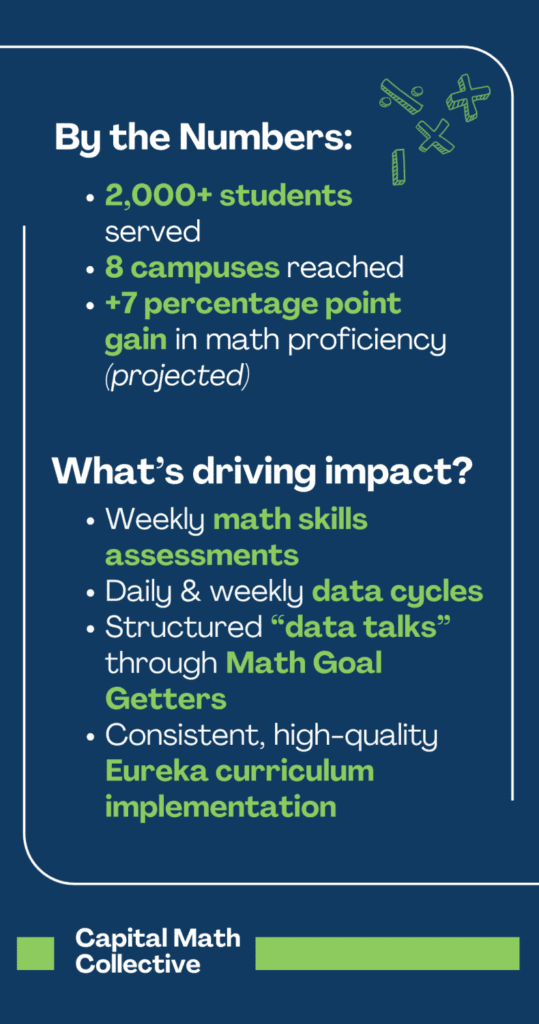
At Friendship Public Charter Schools, more than 2,000 students across eight campuses are on track to increase math proficiency by 7 percentage points this year. What’s driving this progress?

Teachers and school leaders are doubling down on:

  • Strong instructional coaching
  • A focus on deep conceptual understanding
  • Weekly math skills data evaluation to target small group supports and interventions

Through initiatives like Math Goal Getters, supported by EmpowerK12’s Math Acceleration Grant, educators use weekly assessments and structured data cycles to pinpoint student needs and adjust instruction in real time. Instructional coaching further strengthens this work, with Math Specialists partnering closely with teachers to turn insights into action—ensuring every student receives targeted, effective support.

In practice, this looks like classrooms where teachers are constantly adjusting instruction based on what students know—ensuring no student falls through the cracks.


Investing in Educators

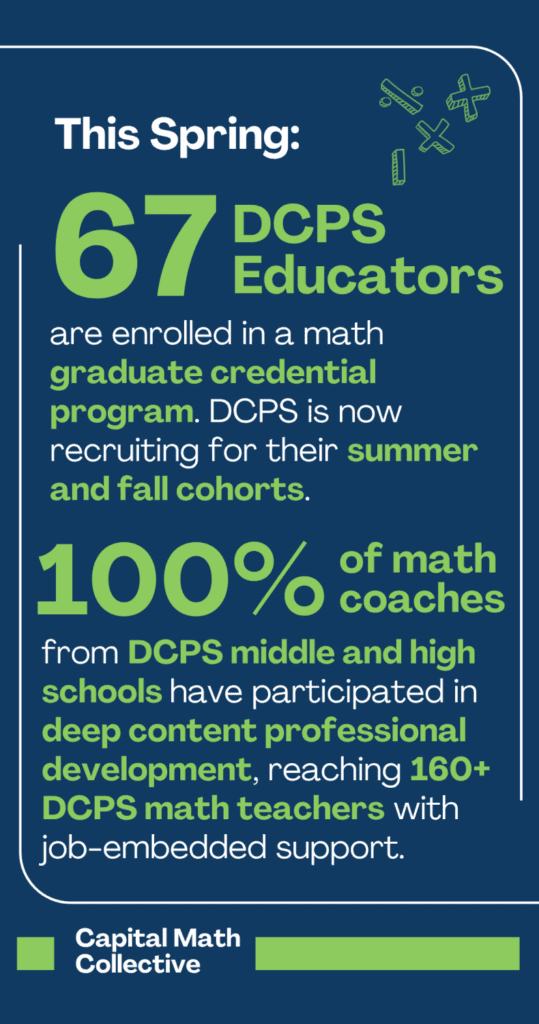
Improving student outcomes starts with investing boldly in the educators shaping math learning every day—and this spring, DC is doing just that through a groundbreaking partnership with Trinity Washington University to expand content-based learning and strengthen the city’s math teaching pipeline.

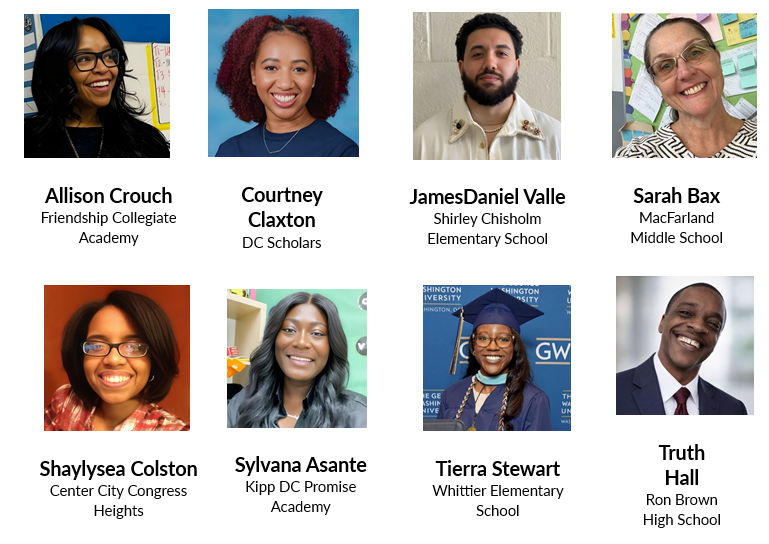
This spring, 8 Bright Spots Math Fellows from DCPS and public charter LEAs have been selected to form the inaugural cohort of a citywide network focused on sharing best practices and strengthening instruction across schools.

Together, these efforts are building a more connected, content-driven math community—equipping educators with the knowledge, tools, and collaboration needed to accelerate student learning across DC.

Thank you to our Capital Math Collective partner EmpowerK12 for launching the inaugural Bright Spots Math Fellows cohort. Meet the Fellows below:


What’s Next?

There’s more ahead this year as we continue building momentum across DC. We’re excited to share a few ways you can see—and be part of—what’s next:

Capital Math Classic at Nationals Park on May 14

→  We’re currently seeking volunteers and judges to help bring this citywide math competition to life and create an unforgettable experience for students. Send an email to Dr. Asia Franks (afranks@empowerk12.org) to get on the exclusive list today!

New gains and bright spots in student math progress

→ Early signals are showing encouraging progress in how students are learning and engaging with math across DC

Continued opportunities to get involved

→ Educators, families, and partners will be able to engage in hands-on learning, events, and initiatives that are building a stronger math community citywide

At the heart of this work is an ambitious goal: ensuring that every student in DC has access to high-quality math learning—and that our city becomes a national leader in math outcomes.

The early signs are promising, and together, we’re building the conditions to sustain and accelerate this progress. This work is only possible because of the collective effort across our city.

Thank you for being part of this work.

Capital Math Collective

The 74: How D.C. Public Schools Elevate Student Voice to Drive Change

Ferebee: To scale school-level innovation, D.C. is codifying promising practices and shifting policies to follow the lead of its innovative schools.

Read the full story here: https://www.the74million.org/article/how-d-c-public-schools-elevate-student-voice-to-drive-change/